Unpacking synchronization patterns between audio cues and payout visuals in emerging studio handheld reel simulations
Zara Schmitt · Aug 18, 2026
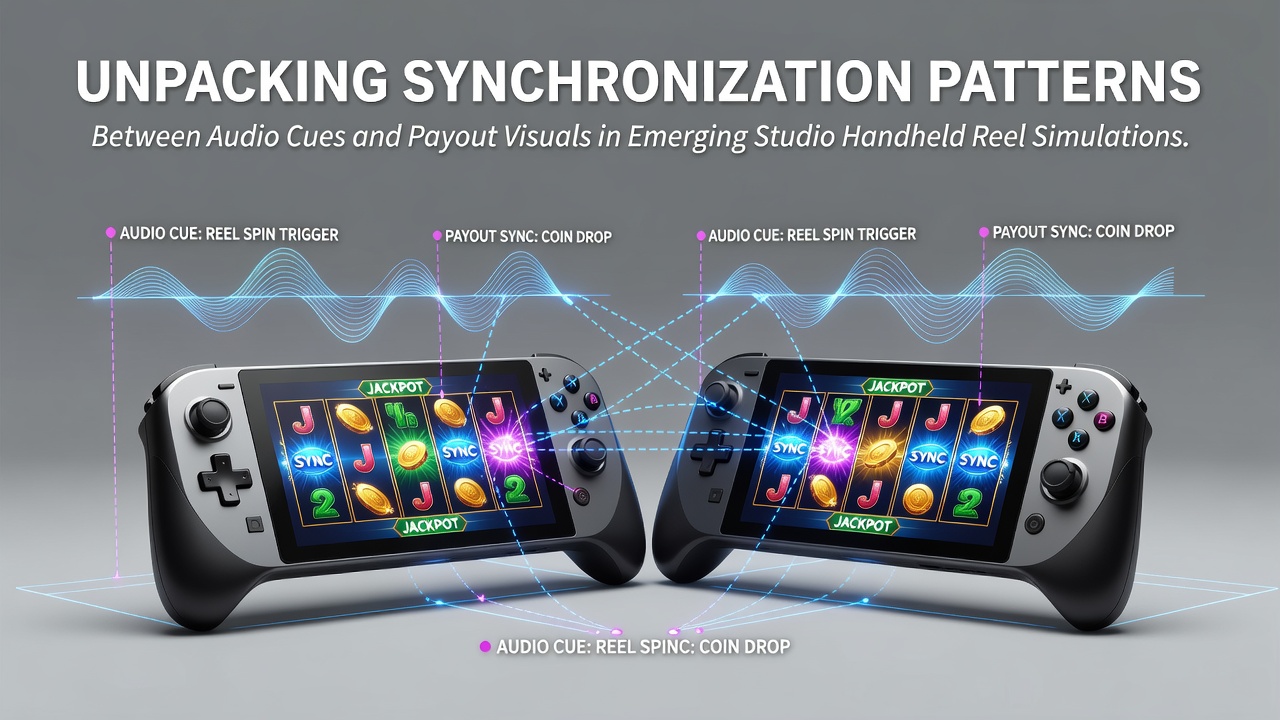
Unpacking synchronization patterns between audio cues and payout visuals in emerging studio handheld reel simulations
Emerging studios have refined synchronization patterns that align audio cues with payout visuals in handheld reel simulations, creating coordinated feedback loops during winning sequences. These patterns rely on precise timing engines that trigger sound layers alongside visual elements such as symbol highlights, meter fills, and particle effects, with developers testing alignments across multiple device frame rates to maintain consistency on touch-enabled platforms.
Core mechanisms in audio-visual alignment
Developers program audio cues to activate at specific thresholds during payout calculations, so that a base win sound initiates simultaneously with the first reel stop animation while layered chimes correspond to incremental value increases displayed on screen. Research from the University of Nevada Gaming Technology Lab indicates that these alignments occur within 16-millisecond windows to match standard mobile refresh rates, allowing observers to note reduced latency complaints in post-release analytics from titles released through mid-2026.
Handheld formats introduce additional variables because screen sizes and processor loads vary across devices, prompting studios to implement adaptive buffering that adjusts sound sample rates without altering visual pacing. Data collected from portable gaming sessions shows that payout visuals expand or contract in tandem with audio intensity curves, producing a unified sensory signal that registers across different operating systems.
Patterns observed in 2026 releases
Throughout August 2026, several emerging studios updated their handheld reel libraries with refined sync protocols that map audio frequency bands to specific payout tiers, such as low-value wins paired with short tonal bursts and higher multipliers accompanied by sustained harmonic progressions. Figures from the Australian Institute of Gambling Research reveal that titles employing these layered mappings recorded higher session continuity rates in regulated markets compared with earlier unsynchronized versions.
One notable implementation involves dynamic audio ducking, where background music volume decreases as payout visuals reach peak animation complexity, ensuring that win-specific sounds remain audible without requiring manual adjustments. Studios achieve this through real-time parameter control scripts that monitor visual element density and modulate audio channels accordingly, a technique documented in technical briefings shared at industry developer forums.

Technical adaptations for portable environments
Emerging studios address hardware constraints by compressing audio assets into modular segments that load conditionally based on payout magnitude, while payout visuals use vector-based scaling to maintain clarity across resolutions. This modular approach allows simultaneous playback of up to four audio tracks without exceeding mobile memory limits, according to performance metrics published by the Canadian Centre for Gaming Innovation.
Observers note that sync patterns also incorporate haptic feedback triggers timed to audio onsets, extending the coordination beyond visual and auditory channels. In handheld simulations released after June 2026, these combined cues appear in bonus round sequences where symbol clusters trigger both escalating soundscapes and corresponding screen shake effects calibrated to device vibration motors.
Measurement and iteration practices
Studios track synchronization accuracy through automated logging tools that record timestamp offsets between audio events and visual state changes during internal testing cycles. Discrepancies exceeding 20 milliseconds prompt code revisions before external distribution, a standard confirmed in engineering documentation from multiple independent developers active in the portable segment.
Player telemetry from August 2026 builds indicates that consistent alignment correlates with extended engagement intervals in free-to-play environments, though studios continue to refine algorithms that predict device-specific delays and pre-buffer assets accordingly. European Gaming Technology Association reports highlight similar practices among mid-sized teams seeking to differentiate their handheld offerings through precise sensory coordination.
Conclusion
Synchronization patterns between audio cues and payout visuals continue to evolve within emerging studio handheld reel simulations as technical frameworks mature. Data from regulatory and research bodies demonstrates measurable improvements in timing precision across 2026 releases, with developers relying on modular asset design and real-time parameter control to deliver coordinated experiences on diverse portable hardware. These developments remain grounded in measurable performance metrics rather than subjective design preferences, supporting ongoing refinement in mobile reel formats.